
Agricola 1991 Our Lodge
Consecrated in 1883, see our 'History' page for a brief history of our lodge
Where?
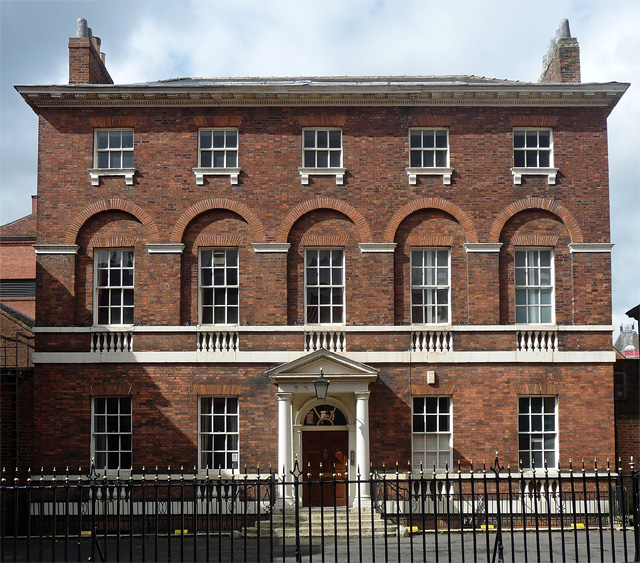
Castlegate House, 26 Castlegate, York, right opposite the well-known Fairfax House. A grade I Listed Building, designed and built by John Carr of York in 1764. It has been the home of Agricola Lodge 1991 since 1928, when the Temple was completed. See also, the Lodge Tour and The History of Agricola Lodge 1991.
A Few Lodge Highlights
There is a school of thought that suggests the 'Temple' is actually the Lodge or Lodge Room; in fact, the terminology is correct in all three cases. Perhaps when not in use, it is a Temple, and when it is in use for a meeting, it is the Lodge
Inside The Temple
We are very proud of our temple and its setting within the magnificent Castlegate House.
Although built later than the rest of Castlegate House, constructed in the 20th century, it was actually designed by the Architect Cecil Leckonby of Walter Brierley Architects in York. The twist in the tale is that Walter Brierley Architects was originally the firm of John Carr Architect, who designed Castlegate House back in 1763.
Regular Lodge Night
Meeting in the temple before the lodge opens for the business of the evening
A regular lodge is quite formal, and the brethren of Agricola Lodge 1991 wear black tie dinner suits. Regular lodge, as it is known, meets on the fourth Monday of each month except bank holidays.
Drinks After Lodge Followed by Fine Dining
Following the business of a regular lodge held on the first Monday of each month, we retire to the bar at Castlegate House before taking our seats in the dining room.
The friendship and camaraderie continue over dinner (festive board) with good food, fine wine, beer and ample toasts. With visitors and guests, the nights are always carried off in good humour.
Frequently Asked Questions
WHAT WE ARE (Purpose)
We are a unique members’ organisation which has thrived for over 300 years. Having no political or religious affiliations, we comprise members of all ages, races, religions, cultures and backgrounds. We meet in our individual Lodges throughout the country where we have ceremonial traditions which encourage us both to be more tolerant and respectful and actively to fulfil our civic and charitable responsibilities; we also make time to eat, drink and meet together, and form lifelong friendships.
WHAT WE AIM FOR (Vision)
To attract those from all backgrounds and walks of life, enabling them to develop into more thoughtful and confident people. To inspire and challenge them to practise the core values we celebrate – Integrity, Friendship, Respect, Service – in their private and public lives. To cement our reputation as a force for good in our communities and society at large and as a thriving organisation that people aspire to join.
OUR VALUES
INTEGRITY: Rather than working on buildings like the masons of old, today’s Freemasons focus on building themselves as people of integrity, and membership provides the structure to help achieve that goal.
FRIENDSHIP: One of the oldest social organisations in the world, Freemasonry is not defined by an ideology. It is open to people from all religions and political persuasions, and provides the common foundation for friendships between members, many of which will last for life.
RESPECT: With a membership of more than 150,000 people drawn from communities across the UK, Freemasonry brings people together irrespective of their race, religion or any other perceived differences that can divide us as a society.
SERVICE: Whether participating in events, fundraising for a charitable cause or volunteering for public or community organisations, service is at the very heart of Freemasonry. Our members make valuable contributions by donating time, resources and skills.
People join Freemasonry for many different reasons; some join for the friendships they will make, friendships that last a lifetime and encompass the key milestones in life, for better or worse. You will meet people who are different to you, those of various ages with radically different life experiences and interests, drawn together by common experience through Freemasonry.
Our members are, and have been for three centuries, drawn from all walks of life. From Captains of industry and chief executives to manual labourers and forklift truck drivers, you will find people with a wealth of different outlooks from all races, religions, classes and backgrounds.
Some enjoy the ceremonial aspects. Our meetings are centred on centuries-old lessons, focused on you as an individual. How you live your life, the decisions you make, and how to become a better person are all found in our meetings.
Freemasons are taught to look after those less fortunate than themselves; charity is our lifeblood, and many members devote their time and energy to helping those less fortunate than themselves.
We also have a lot of fun along the way; we eat, drink, and meet together, and form lifelong friendships.
There are three ‘degree ceremonies’ performed during masonic meetings. They are essentially one-act plays and teach members how to be better people, and each play represents a different stage in life.
As an ‘initiate’ or Entered Apprentice, Freemasons are taught we are all born equal, we learn that in life some do better than others and it is up to those that do well to look after the less fortunate. From this stems our belief in the importance of Charity.
The next stage is to become a ‘Fellow Craft’ where Freemasons are taught the importance of improving yourself as a person, and finally as a ‘Master Mason’, where we learn that we have but one life, and the importance of using it wisely.
The details of the ceremonies can easily be accessed online, but nothing beats experiencing it for yourself.
After the meetings, members dine together informally in order to enjoy good food, good wine, and good company. And most importantly, to have fun together.
The aprons stem from our historical and symbolic roots as stonemasons. Being leather, they were designed to protect them from sharp tools and rough stones. For today’s Freemasons, the apron is a mark of their membership. They are presented with a white leather apron, and as they progress, this becomes more elaborate.
Only men aged over 18 are allowed to join the United Grand Lodge of England in England and Wales.
The two leading women’s Grand Lodges, that we have the closest relationship, with are: Freemasonry for Women and the Order of Women Freemasons. These two groups only admit women because that is the choice of their memberships. Both of the women’s organisations, and ourselves, prefer to practice our Freemasonry in single sex environments. The United Grand Lodge of England regularly hires its facilities out for meetings of the two women’s Lodges due to our mutual respect and close relations.
It is the sheer scale. We are one of the biggest charitable givers in the country and gave £51.1m to charities in 2020 alone.
The Masonic Charitable Foundation, the Freemasons’ Charity – our national charitable grant giving arm, tackles some of the most significant challenges facing society, in particular, reducing loneliness in later life and ensuring a positive future for young children. We work in partnership with some of the biggest charities in the country to deliver our support.
Freemasonry also does a huge amount for medical research into treatments for cancer, diabetes, heart disease and a whole range of other conditions. In addition it makes donations to support those affected by overseas disasters as well as those at home, such as the Grenfell Tower disaster.
During the Covid Pandemic Freemasons working together to help their communities. The United Grand Lodge of England, and its members, are doing all they can to help in the fight the coronavirus. We have seen remarkable stories from across the country of how our members came together – from helping to raise vital funds for the NHS and delivering food to the community, through to purchasing ambulances and manufacturing vital personal protective equipment (PPE). To support Freemasonry’s charitable response to the coronavirus pandemic, UGLE and the Masonic Charitable Foundation, the Freemasons' charity, established the Freemasons’ COVID-19 Community Fund.
This Fund has helped to support a range of local and national charities and projects that are helping people through the current coronavirus pandemic and in total has donated £3m during the pandemic.

© 2026.Agricola Lodge 1991. All rights reserved.