
The History of Agricola Lodge 1991: the beginnings of the Lodge and its Consecration.
From Roman times through the ages, York has been a principal Military Centre of the North.
It is not surprising that from a gathering of Masons, predominantly Military men or sympathisers, the name of the illustrious Roman General Agricola should be chosen as the name for their new Lodge. Agricola had close relations with York and was instrumental in laying the foundations of order and education here. What better name, to be a constant reminder of what was best and praiseworthy in Man.
Agricola Lodge No.1991 was consecrated by the Deputy Provincial Grand Master, Yorkshire North & East Ridings, W. Bro. John Hall on 12th April, 1883.
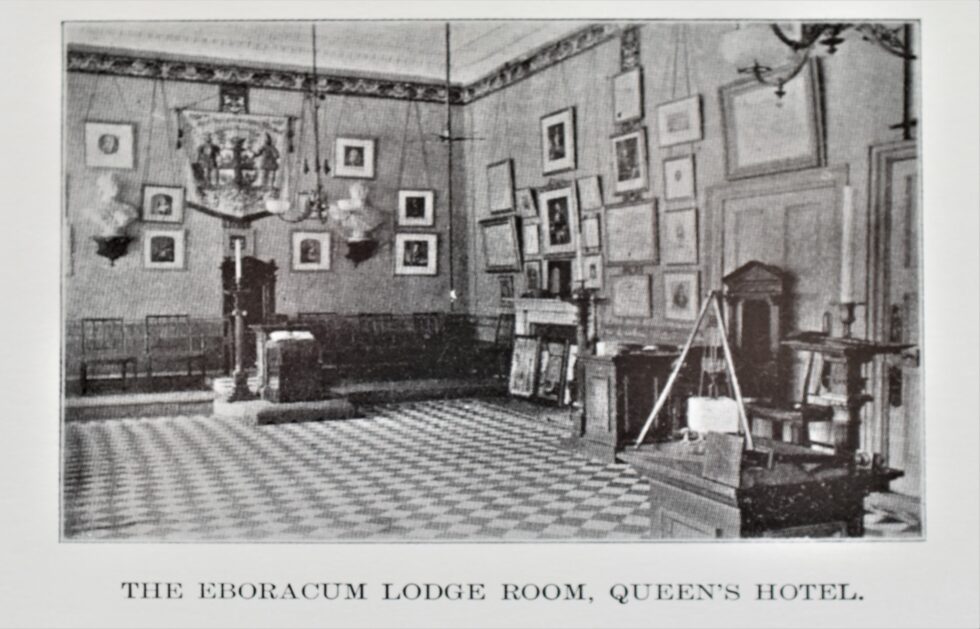
The Consecration was held in the Lodge Room of Eboracum Lodge, 1611, at The Queen’s Hotel, Micklegate, opposite St. John’s Church (1131 to 1934) at the corner of North Street. The Queens Hotel was later demolished and replaced with what is now Queens House.
The Travelling History of Agricola Lodge
Agricola Lodge has had many homes. The following content lists the buildings used since the Consecration. Finally resting in one of York's most notable buildings.
The Queens Hotel, Micklegate, York 1883 - 1884
The interior of the Hotel was “one of the best early Georgian buildings in the Country” The Lodge Room took up most of one floor, and Agricola Lodge was given use of all necessary Masonic requirements by “Mother” Eboracum Lodge.
The last Lodge held at the Queens Hotel was on 26th May, 1884. The reason for the move? Brethren desiring to meet on unlicensed premises!
The fact that the room fee had practically trebled in a Year, and that Hotel users may have remarked about the noise made by Military drill exponents when processing round the Lodge, may also have had some bearing on the decision!
No.3 Peter Lane, York 1884 - 1888
An Emergency Lodge was held at No. 3, Peter Lane, a private house, on 9th June by dispensation, with regular Lodges being held there for four years. No consecration is recorded. Mr. R.C. Flint, son of Bro William Flint, became the first Lewis of the Lodge on 28th July, 1884, in a double ceremony with Staff Sgt. R.B. Adams.
An unfortunate accident is recorded in 1887, when the then Master, W Bro Edward Harding died after being run over by a Horse Tram.
27 Castlegate, York, (Fairfax House) 1888 - 1900
By 23rd April, 1888, the Lodge had moved to the former Liberal Club at No. 27 Castlegate (Fairfax House) and shared by several tenants, including the City Club. The lease of this floor was £20 per annum. This date marked the installation of Bro. A.M. White as WM by the Rt. Hon. Lt. Col. Orde Powlett, Right Worthy (RW) Deputy Provincial Grand Master, with other Provincial Officers, to personally install the Worshipful Master.
By the end of that Century, 223 members had joined or had been initiated into Agricola Lodge, including 34 Officers and 69 Senior NCOs, parity in membership being achieved while in 27 Castlegate. Ceremonies with multiple Candidates in all Degrees had reduced somewhat by that time.
The last Lodge at this venue was held in March 1900.
12 Ogleforth, York, (Old Brewery) 1900 - 1910
The Lodge moved to No. 12 Ogleforth (the Old Brewery – now converted to flats) and yet another Temple was Consecrated. The Lodge commenced Masonic Business there on April 23rd of that year, and Bro James Pickersgill Gill was Installed as Master for the first time. 85 brethren being in attendance. In April 1902 Bro Robert Rook was Installed as Master for the first time.
St. Saviourgate, York 1910 -1923
1910 signified the return of Agricola Lodge to the bosom of its Mother Lodge, Eboracum 1611, now at the Mechanics’ Institute, St. Saviourgate, its present abode. By that time, the total number of joining and initiated members for the decade numbered 84. It was however, notable, that a number of family business owners, across the representative life of the city, had joined the Lodge since its inception, together with many shop, public house and hotel owners. These formed the core of a stable and active membership.
Social life was greatly enjoyed; Dinner Dances and Balls were much in favour. Charabanc outings to the Coast, ladies in Edwardian summer finery, magnificent hats. The Military out-doing their more soberly attired Brethren with Dress Uniform. Whether all headgear, scabbards and colourful No 1 Dress went on the journeys is not certain.
The Ebor Hall, Coney Street, York 1923 - 1928
The Ebor Hall, (or part thereof) built for the York Evening Press in 1851 (the main part fronting onto the Ouse), became available. It was bought from the Yorkshire Herald for £6,000, towards which members donated £1,550, the last Lodge was held at St. Saviourgate on 24th March, 1924.
Euphoria waned quickly. A new GPO Radio-telephone mast on the roof above the Lodge room vibrated in the wind; new Printing Presses in the adjacent main building becoming an even more constant nuisance during Ceremonies and other functions.
Castlegate House, 26 Castlegate, York 1928 - Present
Still searching for the ideal “home” Castlegate house became available. Negotiations commenced, and the Lodge will ever be indebted to a notable, shrewd character in the person of W Bro Edward Walker, who was twice Lord Mayor of York. It was he who negotiated the sale of the old premises at a handsome profit, and the purchase of Castlegate house at a very favourable figure.
On the 19th September 1927 the house was bought from Dr Hood for £3,500 and on the 25th November 1927, Walter Brierley’s Architects were commissioned to design a Temple and internal house alterations. Walter Henry Brierley was a York architect who practised in the city for 40 years. He is known as "the Yorkshire Lutyens". He is also credited with being an exponent of the "Wrenaissance" style - incorporating elements of Christopher Wren.
Castlegate House has become the permanent home to Agricola Lodge, as well as three other Lodges currently.
© 2026.Agricola Lodge 1991. All rights reserved.